
Editorial analysis | Sellvia.biz Research Desk
An order notification is an event, not an income statement. That is the first distinction we made when building a new per-order ledger for Sellvia. A digital guide can have a $50 catalog reference price, generate an attributed order, and appear alongside an encouraging commission estimate. Yet none of those numbers tells the operator exactly how much economic value the order creates. The answer depends on its source, the commission actually allocated, the charges attached to approval, the cost of promotional delivery, and the expenses that belong to the business rather than to an individual transaction.
For this investigation, our editorial desk constructed a set of controlled hypothetical orders, applied the fee categories described in Sellvia’s currently published terms, and checked the arithmetic independently. We did not submit a live order, withdraw money, or gain private access to an account for this report. That matters: the numerical examples are original research models, not a disguised earnings testimonial. They are designed to help an operator audit their own dashboard line by line.
Quick answer: a useful Sellvia unit-economics calculation begins with allocated commission, not the customer’s catalog reference price. It subtracts applicable order-approval charges, a defensible share of promotional delivery costs, and, for a more complete view, relevant recurring expenses and redemption costs. The result is a modeled contribution for decision-making, not a promise that Sellvia will award or pay the same commission on a real order.
The starting number is not your revenue
Consider a digital checklist listed at a $50 Catalog Retail Price. In a conventional merchant checkout, it can be tempting to treat $50 as merchant revenue. The Sellvia Partner Account model requires a different reading. Under the current Terms of Use, commission is a Sellvia-funded promotional incentive, not a transfer of the end customer’s payment. The retail-price figure is a reference for fee calculations and potentially for Sellvia’s internal commission determination, not proof that $50 belongs to the partner.
That distinction protects an analysis from a surprisingly large error. If an article starts with $50 and calls every subsequent deduction a cost to the partner, it has already classified the customer transaction incorrectly. Instead, we keep four columns separate: Catalog Retail Price, partner commission, approval payments, and advertising or other business spending. The commission is not fixed by the catalog price; Sellvia states that it determines the amount at its discretion. Any comparison involving a specific commission number must therefore mark that number as an assumption until an actual account entry confirms it.
The platform also distinguishes Sellvia Ecosystem orders from Customer Store Orders. In the latter configuration, a seller may use their own payment integration, and the commission program described for ecosystem orders does not apply in the same way. We do not mix the two models. Everything in the worked example below concerns attributed Sellvia Ecosystem digital-product orders and uses a hypothetical commission only to demonstrate the accounting method.
Build a ledger that answers one question at a time
Our working ledger uses seven fields: order identifier, attribution type, Catalog Retail Price, potential commission, approval charges, advertising-delivery allocation, and final contribution after operating overhead. We add two separate status fields: whether approval has been completed and what portion of any commission has become available for redemption. Those status fields stop an economic estimate from being mistaken for available cash.
We tested our model by changing just one input at a time. When the assumed commission moved from $32 to $28, the contribution moved by exactly $4. When approval changed from individual to automatic on a $50 order, the applicable approval surcharge changed by $7.50. When a promoted order required more advertising allocation, the contribution fell by that additional allocation. These simple tests are not dramatic, but they are the kind of audit that makes a model trustworthy.
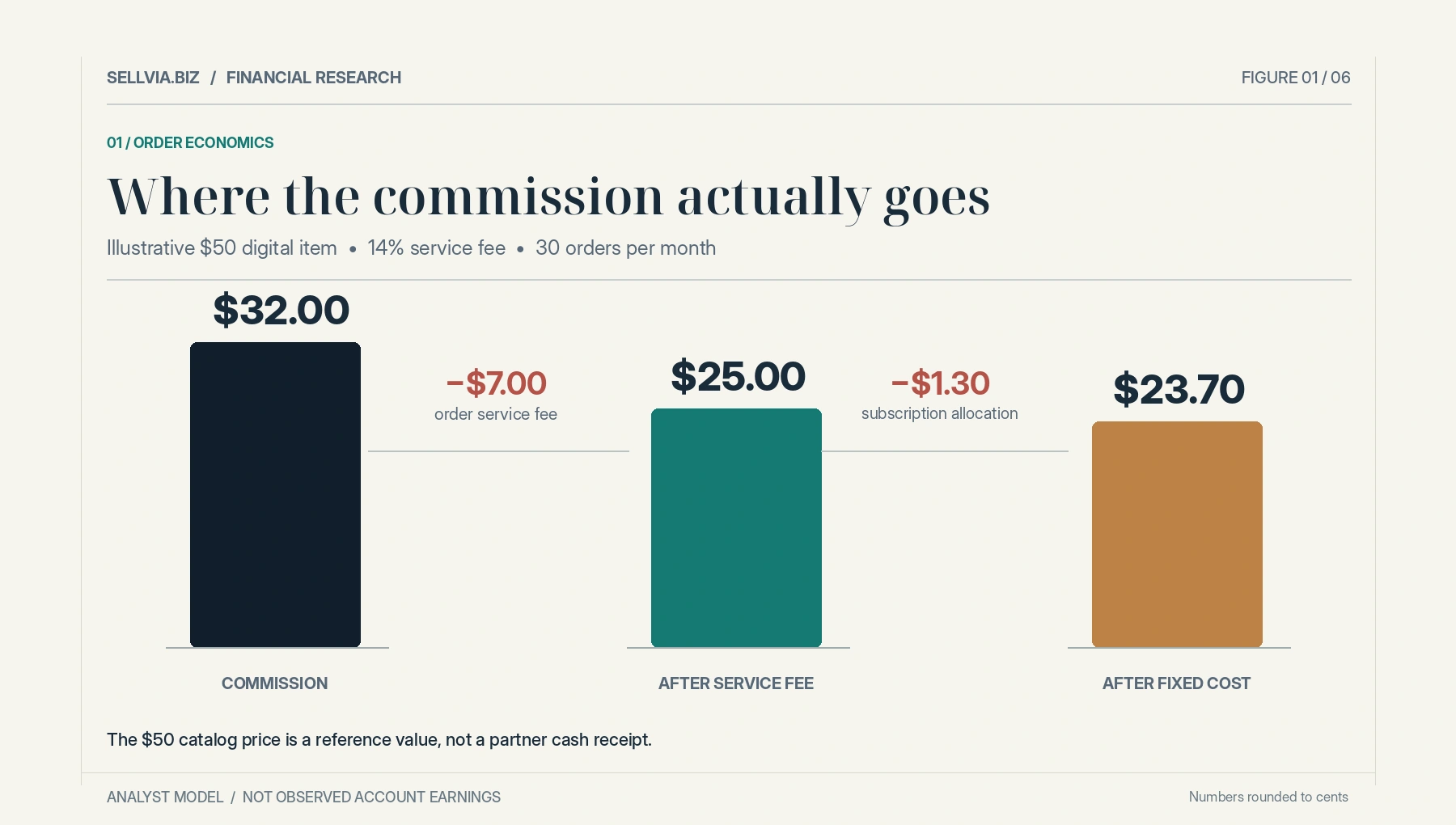
A $50 organic digital order, worked line by line
Start with an organic Sellvia Ecosystem order containing one digital guide with a $50 Catalog Retail Price. Assume, solely for this illustration, that Sellvia allocates $32 in commission and that the applicable Order Service Fee rate is 14%. The current Terms describe a rate range of 10%-18%, so the 14% figure is a middle-case modeling choice, not a quotation for every account or product.
For a qualifying digital organic order, the current fee summary shows no CPA Fee and no Product Cost Charge. The Order Service Fee still applies. At 14% of $50, it is $7. With individual approval, there is no additional method-of-approval surcharge. The modeled per-order contribution is thus $32 – $7 = $25, before subscription allocation, any other operating expense, possible commission changes and redemption costs. The $50 catalog price remains a reference price; it is not added to the partner’s income in this calculation.
Now assign fixed expenses. Suppose a store has a $39 monthly base subscription and exactly 30 qualifying orders in the period. A simple per-order subscription allocation is $39 / 30 = $1.30, making the modeled result $23.70 before any other costs. That is an allocation method, not an additional charge triggered by this particular order. With only ten orders, the same subscription would represent $3.90 per order. The economics have not changed at the transaction level; the capacity to absorb fixed cost has.
The model should not deduct the $7 Order Service Fee twice. A common spreadsheet error is to subtract it once as a processing cost and again under “platform commission.” In this calculation, the Service Fee already occupies that category. If there are additional actual transaction fees, enter those as their own line item rather than assuming they are included or absent.
| Illustrative item | Amount | Treatment |
|---|---|---|
| Catalog Retail Price | $50.00 | Reference only; not partner income |
| Assumed allocated commission | $32.00 | Hypothetical starting point |
| Organic Order Service Fee, 14% | -$7.00 | Actual rate must be checked |
| Individual-approval surcharge | $0.00 | No extra method fee |
| Contribution before fixed costs | $25.00 | Modeling result |
| Subscription allocation, 30 orders | -$1.30 | Illustrative fixed-cost spread |
| Contribution after allocation | $23.70 | Before other applicable costs |
Why a promoted order needs a second calculation
The cost architecture changes when an order is classified as promoted. Under the current terms, the Promoted Order carries a catalog-specific CPA Fee and a CPA Service Fee. It does not carry the organic Product Cost Charge. The promotion service also uses Ads Credits: the current terms describe a 28% management charge applied when Ads Credits are used for promotional delivery, on top of the credits delivered that day. Those promotional expenses need a separate allocation to orders rather than being treated as a flat platform commission.
Build a controlled companion case using the same $50 reference price and assumed $32 commission. Choose a hypothetical $11 catalog CPA Rate, a 14% CPA Service Fee ($7), and $8 of delivered Ads Credits allocated to one acquired order. The 28% promotion fee attached to that delivery is $2.24, producing $10.24 in modeled promotional cost. Individual approval adds no method surcharge. The calculation becomes $32 – $11 – $7 – $10.24 = $3.76 before fixed expenses.
That $3.76 is not evidence of an actual Sellvia margin. We deliberately held commission and product reference value constant to isolate cost mechanics; real promoted and organic orders need not share the same commission or attribution outcome. The editorial value of the example lies in the sequence of deductions, not in treating $3.76 as a forecast. A business should substitute the catalog CPA Rate, actual fee rate, recorded commission and genuine daily advertising consumption seen in its account.
One other caution: $8 of Ads Credits applied to delivery is not the same as $8 spent purchasing credits. Credits can be topped up before being consumed. When evaluating unit economics for a period, use the delivery and fee that belong to that period, and reconcile purchases separately in cash-flow records. Otherwise a top-up made today can distort the apparent economics of yesterday’s orders.
The three profit-like numbers operators tend to confuse
We use order contribution for commission minus charges and variable marketing expenditure. We use operating result for the period-level sum after fixed and variable expenses. We use cash recovered for money actually received through eligible redemption after any payout charges. These three metrics can all be positive or negative in different combinations, and none should substitute for another.
For example, imagine five organic orders with $25 modeled contribution each. They produce $125 of modeled order contribution; after the hypothetical $39 subscription, the period figure is $86 before other costs. That does not mean $86 is currently transferable to a bank account. Commission may still be Pending, Incoming, staged, reserved or subject to payout eligibility. The Terms describe validation windows and method-specific redemption charges. Until a payout is approved and settled, the internal commission balance is not external bank cash.
It also works in reverse. A partner might have some previously accumulated Available Commission while newly acquired orders are producing negative contribution at current advertising costs. Available balance may help operational liquidity, but it does not rescue an inefficient acquisition method. The contribution calculation and the liquidity calculation should sit next to each other, not overwrite each other.
Where an apparently small approval choice becomes material
Approval method is not a cosmetic workflow setting. The current schedule distinguishes individual approval at no extra method fee, bulk approval at 7% of Catalog Retail Price per included order, and automatic approval at 15%. The common CPA Service Fee or Order Service Fee remains applicable on top. For our $50 digital organic example, that means an extra $3.50 when approved in bulk or $7.50 when approved automatically, assuming those options apply to the order.
The original $25 modeled contribution therefore becomes $21.50 for bulk approval or $17.50 for automatic approval, before fixed costs. The difference may be worthwhile if it prevents missed approvals or eliminates labor that genuinely costs the operator more. But it should never disappear from the spreadsheet simply because the workflow is convenient. Method-of-approval fees are not the same as the base order service charge.
There is also a distinct late-approval scenario: the current terms describe a possible 9% Late Approval Fee, alongside automatic approval and other applicable charges, where Sellvia applies Available Commission to an otherwise unapproved order under the specified rule. This is not the standard cost of choosing manual approval. It is a conditional exception requiring an explicit line in a risk scenario, not a blanket assumption for every order.
A sensitivity test worth running before scaling
We built a miniature stress test rather than extrapolating one favorable order. Keep the $50 reference price and 14% service fee, but vary commission across $20, $26 and $32. For an individually approved organic digital order, the modeled contributions are $13, $19 and $25. All three are positive before fixed expense. Yet at ten orders per month the $39 subscription consumes $3.90 per order, while at 100 orders it consumes only $0.39. Volume changes the significance of the same fixed charge.
For promoted orders, hold a hypothetical $11 CPA Fee and $10.24 delivered-promotion allocation constant. Contributions become -$8.24, -$2.24 and $3.76 at the same three commission assumptions. This isolates the possibility that stronger demand volume can still fail to create economic value if the acquisition spend is too high relative to the commission actually allocated. We have intentionally not invented conversion rates, platform traffic figures or earnings statistics to decorate the model.
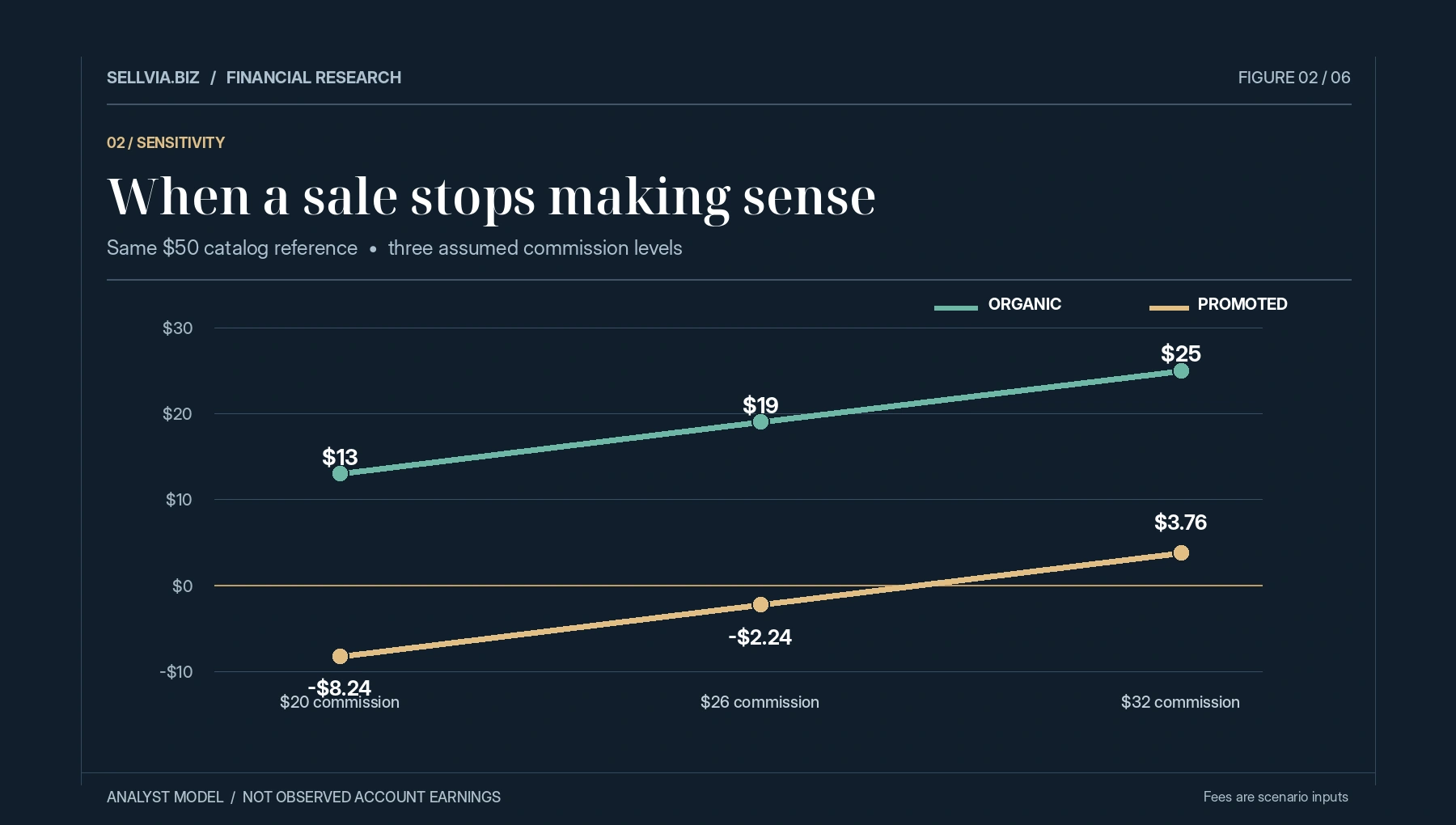
Run that test with your own observed values and then change the CPA allocation. If a promoted order initially has $8 in delivery and costs $10.24 after the 28% fee, doubling delivery allocation to $16 doubles that modeled ad expense to $20.48. The relationship between ad spending and order count, however, is rarely so neat. A real campaign’s cost per acquired order must be calculated from total delivery and the eligible attributed orders over a consistent period.
What the model leaves out on purpose
A precise editorial model needs boundaries. We do not put bank-transfer fees into a transaction-level cost unless we have chosen a defensible method for allocating them. We do not treat subscription fees as variable charges for each transaction. We do not insert taxes, currency-conversion costs, extra subscriptions or refunds as zero by default; instead, the reader should add any actual amounts. And we do not assume a commission amount from an illustrative percentage in marketing copy.
The assumptions matter especially for the digital-only catalog considered here. The current terms distinguish digital orders from physical merchandise in their Product Cost Charge schedule. Adding shipping boxes, warehouses or physical inventory cost to the calculation would introduce a separate business model that is not being evaluated in this report. The relevant costs for an attributed digital order are the charges that actually apply to its source, approval method and promotional activity.
Similarly, the model cannot prove that a particular commission will pass validation, that a payout request will be approved or that a given store will receive a particular number of orders. Those outcomes depend on account events and platform review. We mark modeled contribution as a provisional analytical number until the underlying record supports each input.
The reconciliation worksheet we would keep open
Our editorial worksheet has a row for every approved order and a second daily sheet for promotion-service consumption. The order sheet records the Catalog Retail Price, classification, allocated commission, CPA or Product Cost Charge if applicable, service fee, approval surcharge and status. The advertising sheet records daily Ads Credits actually applied to delivery, the related service fee, and the attributed promoted-order count. A third summary sheet distributes recurring expenses over the chosen reporting interval. Reconciliation is easier when all three sheets use the same start and end dates.
At week end, we would run four checks. First, does the sum of per-order service fees match the account’s recorded charges? Second, do the promoted-order counts align with the attribution report, without pulling organic orders into the denominator? Third, does ad delivery plus its fee reconcile to the decline in usable Ads Credits after accounting for purchases or adjustments? Fourth, are Available Commission and bank transfers kept outside the contribution formula until we intentionally calculate cash recovery? These are audit questions, not claims that we accessed a live account for this study.
If one number does not reconcile, we would not “fix” it by inventing a margin. We would flag the row, capture the applicable dashboard transaction details and revise the input. A model that admits an unresolved transaction is better than one that produces a perfectly smooth graph from inconsistent data.
What Sellvia gets right, and what requires discipline
Sellvia brings order attribution, catalog reference pricing, account charges, promotional delivery and commission tracking into one operating ecosystem. That can make building a per-order view more manageable than stitching together unrelated software services. The benefit is not that costs vanish. It is that a serious operator has recognizable financial categories to reconcile and a defined sequence for processing and commission validation.
The discipline falls on the reader. No platform can decide whether a $7.50 approval surcharge is worthwhile for a particular business without knowing the owner’s time value, staffing and order volume. No published rate can guarantee the commission for an individual transaction. This is where unit economics becomes a management process rather than a marketing slogan.
Our editorial conclusion is straightforward: begin with confirmed commission, separate every applicable fee by source and approval method, allocate promotion costs consistently, and only then judge the value of the next order. That is more conservative than quoting catalog value as earnings, but it is much more useful for a long-term Sellvia business.
Practical FAQ
Is a $50 Sellvia digital product order worth $50 to the partner?
No. The Catalog Retail Price is a reference figure and is not automatically the partner’s income. Commission is determined separately under the program. For meaningful unit economics, start with the commission actually associated with the eligible order.
Do digital organic orders have a Product Cost Charge?
Under the currently published order-fee summary, qualifying digital organic orders have no Product Cost Charge, while the Order Service Fee and applicable approval-method charge still apply. The specific account and transaction should be checked before acting.
Is the 28% Sellvia promotion-service fee applied when I top up Ads Credits?
The current terms describe it as an additional charge on Ads Credits applied to delivery, not on the purchase or top-up itself. Financial reconciliation must separate credit acquisition from usage.
Can a profitable order still leave me short of cash?
Yes. A modeled positive contribution is not the same as Available Commission or a completed bank payout. Processing, verification, staged allocation, redemption eligibility and payout fees can all affect the timing and amount of cash recovered.
What is the best first spreadsheet metric?
Track confirmed or provisionally allocated commission minus the actual order-specific charges, with attribution and approval method preserved. Keep promotional delivery and fixed expenses in connected, separately labeled fields so the model can be reconciled.
Sources and editorial method
We reviewed the published Sellvia Terms of Use, especially the order definitions, commission provisions, promotion-service charge and order-approval fee schedule. For the broader difference between commission and liquidity, see our Sellvia cash-flow analysis and break-even study. Our numerical cases were calculated by the Sellvia.biz editorial desk using explicitly hypothetical inputs. We have not represented those calculations as live orders, personal payouts or guaranteed results. Fees and dashboard configurations can change; the current account transaction preview and published terms should control any real financial decision.

Daniel Roberts is an ecommerce writer and digital business researcher at Sellvia.biz. He specializes in exploring Sellvia’s tools, pricing, advertising features, order management processes, and overall platform structure. Through clear and practical articles, Daniel helps beginners understand how the platform works, estimate potential operating costs, compare available options, and make informed decisions when building an online business.