
Independent comparison | Sellvia.biz Research Desk
Two orders for the same digital guide can appear in the same Sellvia partner environment and carry meaningfully different economics. The difference may have nothing to do with the buyer, the quality of the guide, or the price shown in the catalog. It may come from attribution. Under Sellvia’s currently published terms, a Promoted Order carries a catalog-specific CPA Fee, while an Organic Order does not. Both can carry an order-related service charge, and the method used to approve them can add another layer of cost. Paid promotion has its own delivery and management charges as well.
We approached this like a side-by-side audit. Instead of assuming that one channel is always more profitable, our editorial team drew a fee map for each order type, built a controlled $50 digital-order case, and changed one input at a time to see where the difference came from. We checked the public terms and our own arithmetic; we did not claim access to Sellvia’s internal attribution algorithm or run real customer campaigns for this comparison. The distinction between public rules and measured account outcomes is essential.
Our finding: for a digital Sellvia Ecosystem order, the Promoted/Organic label changes the charge stack. But the label alone does not establish a winner. The real comparison requires the allocated commission, the catalog CPA Rate where applicable, the service fee, the promotional delivery expense, and the exact approval method. A simplistic “paid versus free” chart hides most of the decision.
Before the fees, ask who classified the order
The terms define a Promoted Order as a Sellvia Ecosystem order attributed to promotion under its Promotion Service. An Organic Order is an ecosystem order not attributed to that service. Attribution can involve identifiers, links, placements or other data used by Sellvia. These are platform classifications, not labels the partner should rewrite to make a report look better. A marketing campaign that feels “organic” to the operator does not necessarily make its orders organic for contractual fee purposes.
For our editorial ledger, the attribution type is a fixed input copied from the actual order record when available. We never infer it solely from the day an order arrived or from whether the operator remembers funding Ads Credits. If the classification is disputed, the appropriate action is to seek transaction-level clarification rather than silently moving the order into a cheaper category. That step makes the later financial comparison credible.
There is a related but separate configuration: a Customer Store Order through the operator’s own payment system. In that case, the customer pays the store directly, and the Sellvia partner commission flow described for ecosystem orders does not apply in the same way. A Storefront Order is also a distinct defined term. This article narrows its scope to Promoted and Organic Sellvia Ecosystem orders for digital products. That boundary is deliberate. Combining all four order labels in one average would answer none of the questions clearly.
The two charge stacks, without marketing shorthand
For a Promoted Order, the published order-approval structure contains a CPA Fee based on the catalog’s CPA Rate for the item, plus the CPA Service Fee. The CPA Service Fee is listed in the 10%-18% range of Catalog Retail Price. Individual approval has no additional method surcharge; bulk and automatic approval can add separate fees. On top of that, the promotion service consumes Ads Credits, and the current terms describe an additional 28% fee when credits are applied to delivery.
For an Organic Order involving an eligible digital product, the current structure does not include that CPA Fee. It includes the Order Service Fee, also in the 10%-18% range. The terms explicitly state that no Product Cost Charge is payable for these digital products, although approval-method charges still apply. This digital exception matters; applying an inventory sourcing percentage from a physical-product scenario would radically distort the result.
Some costs are channel-specific and some are not. A base subscription is a period expense whether today’s orders were promoted or organic. A bank redemption fee may matter to cash recovery for either channel. A bulk-approval surcharge can affect both. The most informative comparison keeps shared expenses visible without using them to obscure the additional cost of acquiring a promoted order.
| Cost or financial input | Promoted ecosystem order | Organic ecosystem order |
|---|---|---|
| Catalog Retail Price | Reference for applicable fees | Reference for applicable fees |
| Commission | Determined by Sellvia, not guaranteed | Determined by Sellvia, not guaranteed |
| Order-specific acquisition fee | CPA Fee at catalog CPA Rate | No CPA Fee |
| Service charge | CPA Service Fee, 10%-18% | Order Service Fee, 10%-18% |
| Product Cost Charge, qualifying digital item | None | None |
| Approval-method addition | 0%, 7% bulk, or 15% automatic | 0%, 7% bulk, or 15% automatic |
| Sellvia promotion-service delivery | Relevant and separately allocated | Not assigned as an organic-order cost in the controlled model |
Our controlled $50 comparison
We wanted one example that a reader could reproduce in a calculator. We set a $50 Catalog Retail Price and a hypothetical commission of $32 for each order. Holding commission equal is not a prediction; it is a research technique for isolating the charge difference. We selected 14% as an illustrative service-fee rate within the published 10%-18% range, so each order has $7 in its applicable service fee. Both orders are individually approved to remove the approval-method variable.
For the promoted case, we then assigned an illustrative CPA Rate of $11 and promotional delivery of $8 in Ads Credits per acquired order. A 28% fee on $8 delivery adds $2.24, creating $10.24 in advertising consumption and related service fee. The modeled promoted contribution becomes $32 – $11 – $7 – $10.24 = $3.76. Notice that we are not subtracting the $50 reference price as a product cost. Nor are we declaring $32 of commission to be guaranteed income.
For the organic case, we subtract only the $7 Order Service Fee from the same hypothetical $32 commission. The result is $25 before shared expenses. The controlled difference is $21.24, made up of $11 in CPA Fee plus $10.24 in promotional delivery and its associated management fee. In this example, the service-charge rate is deliberately identical, so it cancels out of the difference. This is a useful way to see the underlying structure without pretending that the same real-world commission would always be allocated to each channel.
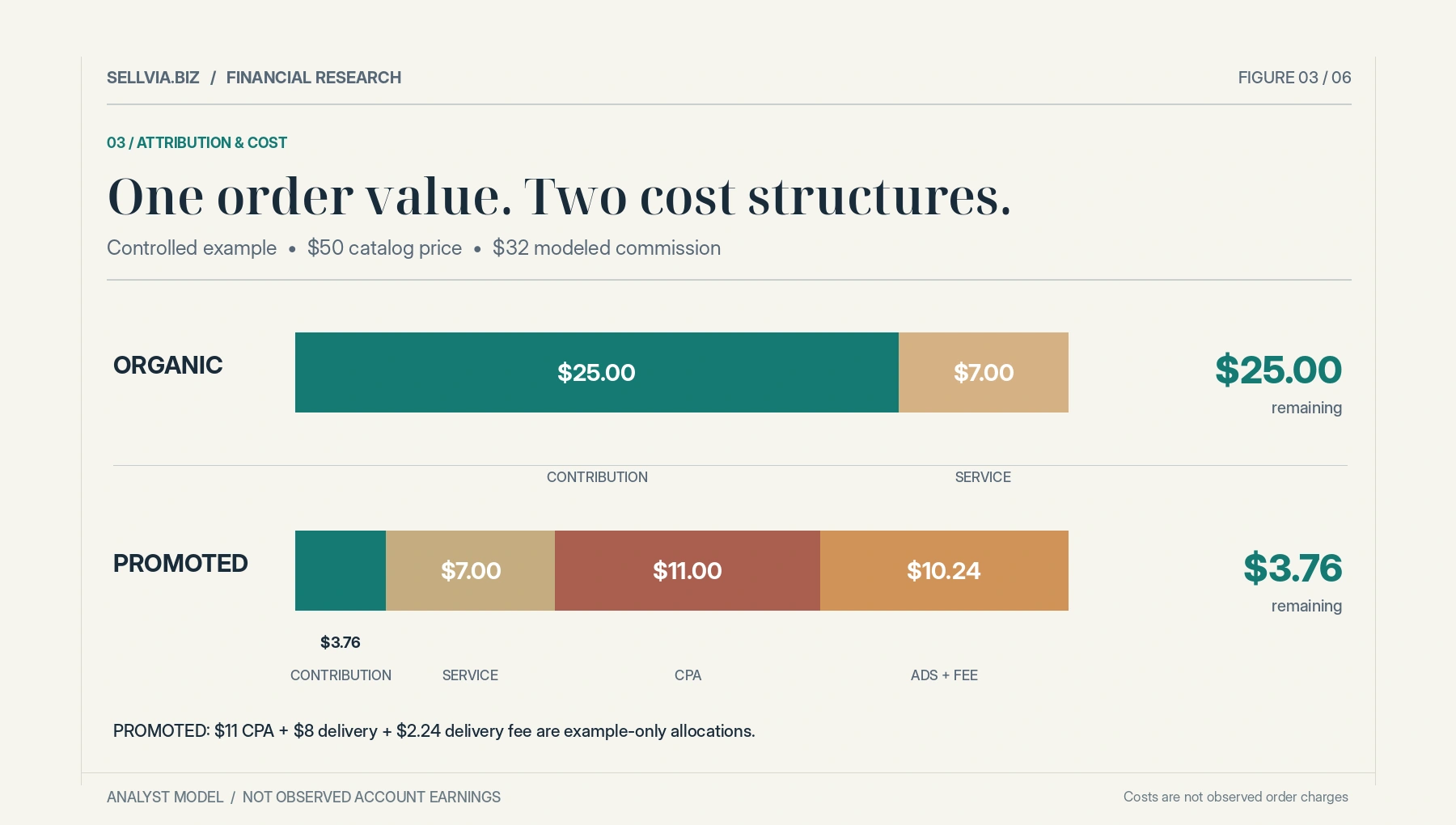
The organic case looks stronger in that narrow comparison. It does not follow that an operator should avoid paid promotion altogether. A zero-acquisition-cost order is attractive but may be scarce or unpredictable. Promoted activity might produce additional qualified volume that the organic channel does not produce. The real question is whether the incremental commission and order volume attributed to promotion are sufficient to cover their incremental expense. That is a business question, not merely a fee-schedule question.
A classification test: three orders that sound similar
Imagine three customers buying the same digital course. Customer A finds an internal placement attributed by Sellvia to its Promotion Service; the order is marked Promoted. Customer B arrives through activity not attributed to that service and is marked Organic. Customer C uses a standalone merchant store with the merchant’s own payment integration. All three may be described conversationally as “sales,” but they belong to different contractual and accounting categories.
For A, a catalog CPA Rate can be charged on approval, as well as the CPA Service Fee. For B, there is no CPA Fee; a digital Order Service Fee remains. For C, the merchant receives its own customer’s payment and must evaluate the applicable service and payment-system costs, rather than dropping that payment into the partner-commission ledger. The first two are the subject of this study. The third needs a separate merchant-income model.
This exercise surfaced one of the biggest reporting hazards: combining orders with dissimilar financial rights under one “average order value” statistic. A blended average can be useful for traffic reporting, but it will not tell an operator which charge follows from which order category. We recommend that every exported order report preserve the exact classification field used in the account, plus a flag for whether the order has actually been approved.
The 28% charge belongs to delivery, not to every sale
A key wording detail in the current terms changes how to prepare a promotional cost report. The 28% Promotion Service fee is described as applying to Ads Credits used for delivery, not to the mere act of purchasing or topping up credits. If $100 of credits is applied to delivery during an applicable period, the illustrated additional fee is $28, for $128 total credit consumption connected to that delivery. The financial ledger should record the consumption and accompanying fee in the period in which they occurred.
That expense is not automatically a neat, identical $10.24 beside each promoted order. Our earlier example allocated $8 of delivery to one order for transparency. Real delivery may produce zero orders one day and several the next. A more robust metric is total promotion-service consumption, including the fee, divided by the number of qualifying promoted orders over a coherent period. If $128 is consumed and four promoted orders are attributed, the average allocated promotional cost is $32 per order, not the $10.24 used in our controlled exercise.
This produces a harder but more useful question: can the additional margin generated by promoted orders absorb the marketing cost per acquired order? If not, increasing the daily budget can magnify the negative contribution. If it can, scaling may be justified by order volume, processing capacity, and available capital. Sellvia’s integrated promotion system can simplify the campaign workflow, but it does not cancel the mathematics of acquisition cost.
Change commission, and the answer changes fast
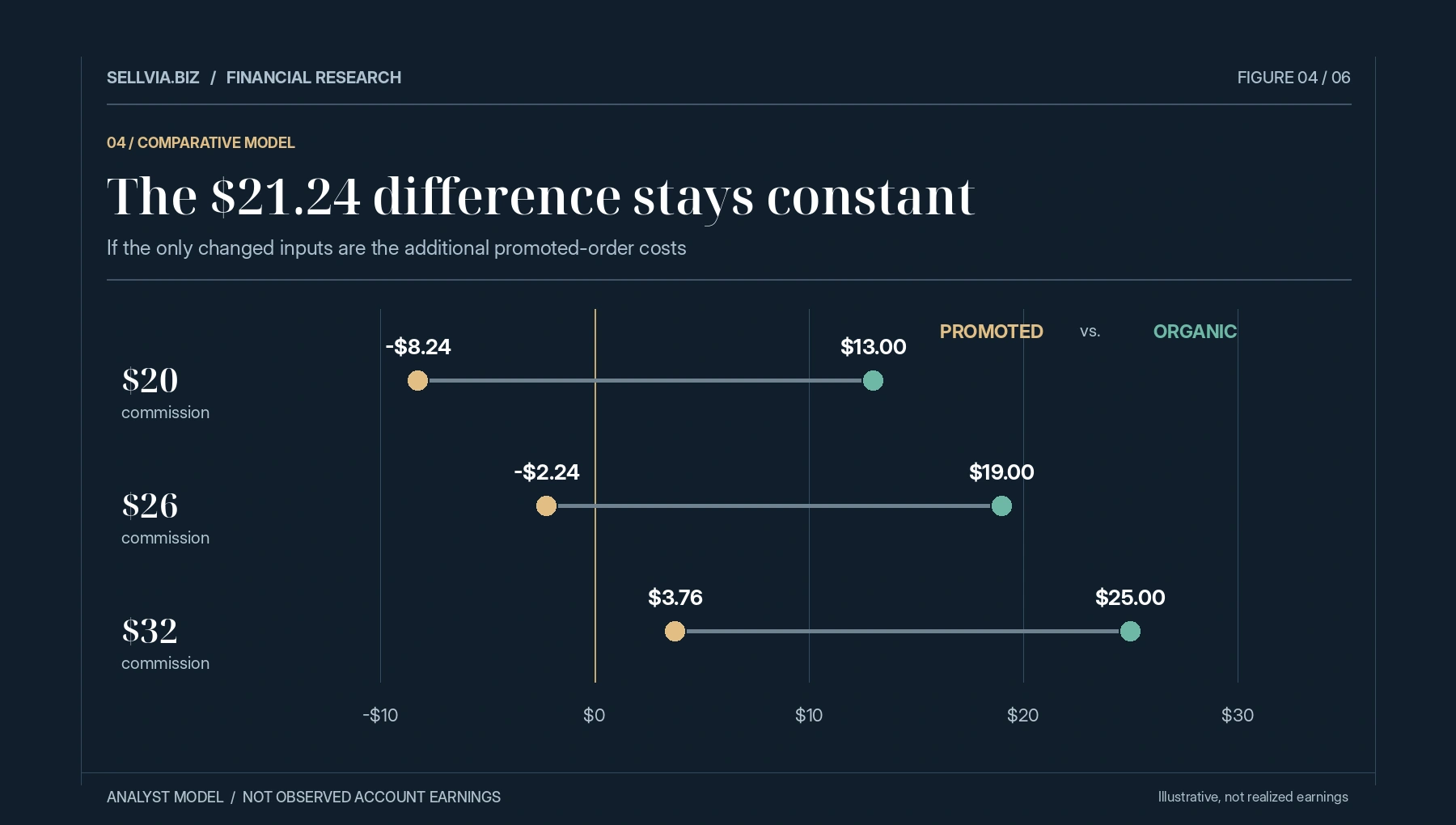
The current Terms describe commission as a discretionary promotional incentive rather than a fixed share of end-customer receipts. We therefore tested a $20, $26 and $32 commission assumption against the same $50 reference-value structure. For organic individual approval with a $7 service fee, the contributions would be $13, $19 and $25. For the promoted case with an additional $11 CPA Fee and $10.24 promotion cost, they would be -$8.24, -$2.24 and $3.76. That makes the role of commission unmistakable.
If an operator used the catalog price as earnings, the conclusion would be absurdly optimistic. If the operator assumed the same commission for every order type, the model would be fragile. The correct workflow is to update the commission input from the actual attributed order or account entry once it exists and leave the historical inputs intact for future review.
We also tested a reversal. What if the promoted order had a higher commission allocation than the organic order? Suppose $40 versus $24, with all other costs left unchanged. The promoted modeled contribution becomes $40 – $11 – $7 – $10.24 = $11.76, while the organic contribution is $24 – $7 = $17. The gap narrows substantially. This does not show what Sellvia usually pays. It shows why attribution type cannot substitute for the actual commission field.
Why a simple ROAS figure can mislead
A promotional performance display can report activity against Ads Credits used, but partner economics require more than a ratio between catalog reference value and promotion spending. The reference price is not automatically partner revenue. Fees on approval and discretionary commission allocation can make two campaigns with similar reported demand look very different in a partner ledger. For this business model, a more relevant operating metric is commission-based contribution after acquisition and approval expenses.
To calculate it, sum commission actually allocated to eligible approved promoted orders. Subtract their CPA Fees, CPA Service Fees and applicable approval surcharges. Subtract the related promotion-service credits consumed and the management fee. Keep the reporting dates aligned. The result is still provisional until commission validation and other expenses are considered, but it offers a clearer economic signal than applying a conventional store-revenue ROAS formula unchanged.
Organic orders deserve the same discipline. “Organic” should not automatically mean “costless.” Content creation, research, website-related tools, subscriptions and the owner’s time can all be real business costs. We have left such shared expenses out of the controlled order comparison because our task is to isolate Sellvia’s defined order-related charges. A full operating statement should bring these expenses back in, using an explicit allocation rather than burying them in a generic deduction.
Approval method can overwhelm the initial difference
Both Promoted and Organic orders can be approved individually, in a bulk operation, or automatically where available. The current terms list 7% of Catalog Retail Price as an additional bulk surcharge and 15% for automatic approval. For our $50 example, those are $3.50 and $7.50 respectively. The normal base service fee remains; the method charge is an additional component, not a substitute. We specifically avoided conflating the two.
If an organic $50 order is automatically approved, its hypothetical $25 contribution before fixed costs becomes $17.50. If a promoted $50 order is bulk-approved, its earlier $3.76 becomes $0.26. That comparison would be unfair as a ranking of channels because we changed the approval method as well as the attribution label. It is useful as a warning: before comparing channel profitability, normalize the approval method or show its cost separately. Otherwise a supposedly channel-driven difference may really be an operational decision.
The late-approval rule adds another contingency. Under specified circumstances, Sellvia can use Available Commission near the end of the approval window and charge a 9% Late Approval Fee together with an Automatic Approval Fee and other applicable charges. That event should appear in a separate exception report, not be interpreted as the normal cost of organic or promoted attribution. A good fee study must separate ordinary choices from exceptional rescue procedures.
The reporting template we recommend
We would keep one worksheet with fields for date, order ID, order classification, Catalog Retail Price, recorded commission, catalog CPA Rate, service-fee percentage and amount, approval method, extra approval fee, processing status, and final contribution. A second worksheet would contain daily Ads Credits used and the 28% management fee, with a transparent rule for allocation to attributed promoted orders. A third worksheet would hold subscription expenses, tools, tax items and eventual redemption costs. Each worksheet would refer to the same reporting interval.
In that structure, readers can answer three separate questions. Does a qualifying organic order generally produce positive contribution at the actual commission and fee values? Is incremental promoted volume covering acquisition charges? And is the business as a whole covering fixed expenses and turning eligible commission into recovered cash? Without that separation, comparing channels becomes an argument about labels rather than a business decision.
A practical monthly review could begin with a two-column summary, but the detailed order ledger should remain accessible. An outlier, a wrong attribution entry or a changed catalog CPA Rate can distort an average. A good summary tells the editor or owner which records must be checked, not which explanation sounds most reassuring.
Where Sellvia’s model is useful
We see a clear analytical advantage in Sellvia’s explicit order classifications and published charge categories: they provide a framework for distinguishing promotion-linked acquisition from non-promoted ecosystem activity. The platform also provides integrated promotional delivery rather than forcing every partner to manage third-party ad accounts. Those features can reduce operational complexity. But the financial advantage only exists if the operator measures the full charge stack and watches actual commission allocations.
Our final position is therefore conditional but practical. Organic attributed digital orders can be less costly at the order-fee level because they do not carry the promoted-order CPA Fee. Promoted orders may justify their added charges when they generate incremental qualifying volume and sufficient commission-based contribution. The only reliable answer is the one produced from the account’s true attribution labels, the corresponding fee entries and a matching promotion-delivery ledger.
FAQ: questions readers are actually trying to answer
Does a promoted Sellvia order always make less money?
No. Promoted orders have additional types of applicable costs, including a catalog-specific CPA Fee, but actual commission and incremental volume can differ. A controlled comparison isolates fees; an operating decision needs real order data.
Is an organic Sellvia digital-product order free to process?
No. The current published schedule still provides for an Order Service Fee and possible approval-method additions. Digital-product status removes the specified Product Cost Charge, not every expense.
Is the 28% ad-management charge the same as the CPA Fee?
No. The current terms distinguish the 28% charge on Ads Credits applied to promotional delivery from the catalog-specific CPA Fee triggered by a promoted order’s approval.
Why not compare catalog retail prices to the advertising budget?
Because in the partner commission model, catalog price is a reference amount, not automatically the partner’s sales revenue. For financial decisions, commission and applicable charges are the relevant categories.
What should I check before calling an order organic?
Use the classification shown in the account and the applicable terms. Do not infer it from intuition about how the customer found the product.
Method and further reading
This independent editorial comparison uses the currently published Sellvia Terms of Use, particularly the definitions of order attribution, the Commission provisions, the promotion-service fee and the order-approval schedule. All scenarios were built and recalculated by Sellvia.biz using assumptions shown in the article. No live transaction, account access or payout has been claimed. For a deeper look at per-order mathematics, read our Sellvia break-even analysis, and for the difference between modeled earnings and usable cash see Sellvia cash flow explained. A reader’s actual account terms and transaction preview take precedence over a hypothetical example.

Erick Borth is an ecommerce writer and digital platform researcher at Sellvia.biz. He covers Sellvia’s business tools, subscription options, built-in advertising features, order processing, analytics, and financial workflows. Erick focuses on presenting platform information in a clear and practical way, helping beginners understand how Sellvia operates, identify the costs involved, evaluate its features, and make informed decisions about starting and managing an online business.